Cultivating Our Capacity as Humans to Thrive With All of Life
A Daoist-Inspired Approach to Human Flourishing
By Sonja Alina den Elzen, R.Ac. ~ Registered Acupuncturist, Chinese medicine practitioner, Daoist-informed teacher, qigong and yoga instructor, and founder of the Living Spiral of Inner Alchemy.
At the heart of my work lies the influence of an animistic Daoist perspective of life.
It is a wisdom with roots reaching back toward the ancient wu: visionary spirit intermediaries associated with divination, healing, ritual, and communication between the human and spirit worlds. Women were prominent among the wu in some periods and traditions. These ways of knowing emerged when human life was held in a far more immediate relationship with the land.
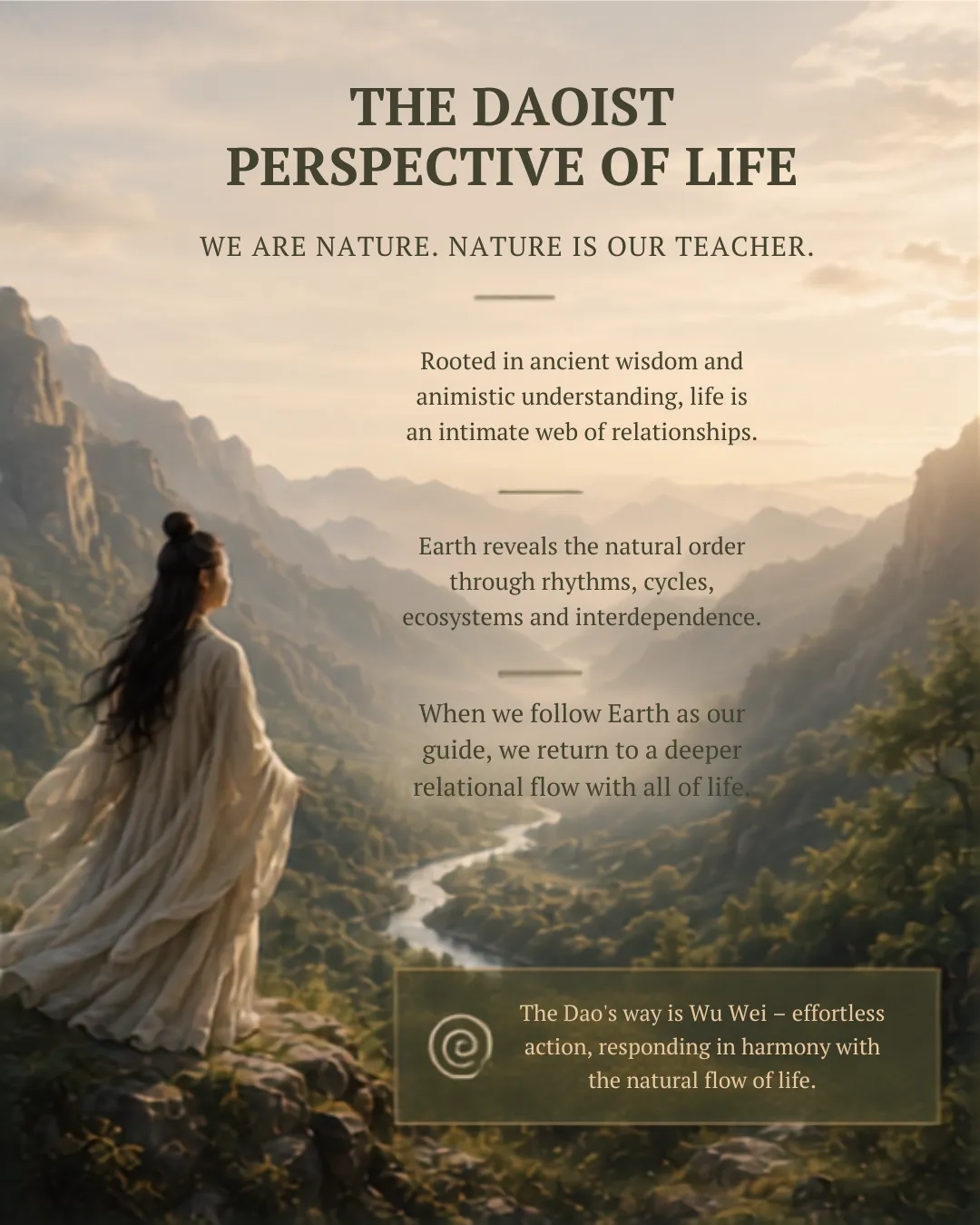
This perspective invites us to remember that we do not stand outside nature. We live within the same rhythms, relationships, and transformations that generate and sustain all life.
What does it mean to cultivate our human capacity to flourish?
To cultivate our human capacity to flourish is to develop the inner qualities that allow us to respond wisely, relationally, and adaptively to life. From a Daoist perspective, human flourishing includes our own well-being, yet it also considers the health of our relationships, communities, waters, forests, air, and the living systems that sustain us.
This understanding moves us beyond self-improvement as an isolated personal project. It asks how we might become more fully human while remaining conscious participants within the larger ecology of life.
What is wu wei in Daoist philosophy?
Wu wei (無為) is commonly translated as “non-action,” “effortless action,” or action that does not force. It does not mean passivity. It describes a way of responding that accords with the conditions, timing, and natural unfolding of life.
Wu wei is the Dao’s way of generating and sustaining all things spontaneously. Humans, following the inherent nature of life, may also benefit from aligning with this natural order.
Earth demonstrates natural order through its rhythms and cycles, ecosystems, and interdependent relationships. If we follow Earth as a primary guide and teacher, we may begin to enter a deeper relational flow with all of life.
We do not need to strive to be in flow. We do not need to react in order to create flow, because reaction often carries an emotional investment in a particular outcome. We may find flow by learning to respond in relationship with what is actually here.
The Stanford Encyclopedia of Philosophy describes wu wei as arising from a supple receptiveness to the moment. This action is spontaneous without being impulsive. It grows from perceiving the possibilities already present within a situation.
How can nature help us understand the natural order?
Nature makes the patterns of change, relationship, timing, and adaptation visible. Careful observation allows us to witness how life moves without separating any one being from the conditions supporting it.
Of course, all of this can remain ideas and words. What is the natural order, and how do we actually recognize it?
I have found that the observation of nature, together with the Five Phases or five transformations of Chinese and Daoist philosophy, offers a clear map. It helps us notice the interactions of energetics, relationships, and life-force energy.
The rising and setting of the sun, the solstices and equinoxes, the flow of water, the growth of plants, and the cycles of the seasons all occur within interdependent processes.
Consider the seed beginning to grow deep below the surface. After the winter solstice, the dominance of yin gradually begins to tip toward yang. The sun starts its return toward longer days. A waking energy gathers below the visible surface before growth appears above the soil.
Nature teaches that movement may begin before we can see it. Timing matters. Rest, emergence, expansion, ripening, release, and return each belong within the whole.
What do the Five Phases teach us about human flourishing?
The Five Phases offer a relational map of recurring movements within nature and human life. Wood, Fire, Earth, Metal, and Water describe patterns of emergence, connection, nourishment, release, and restoration.
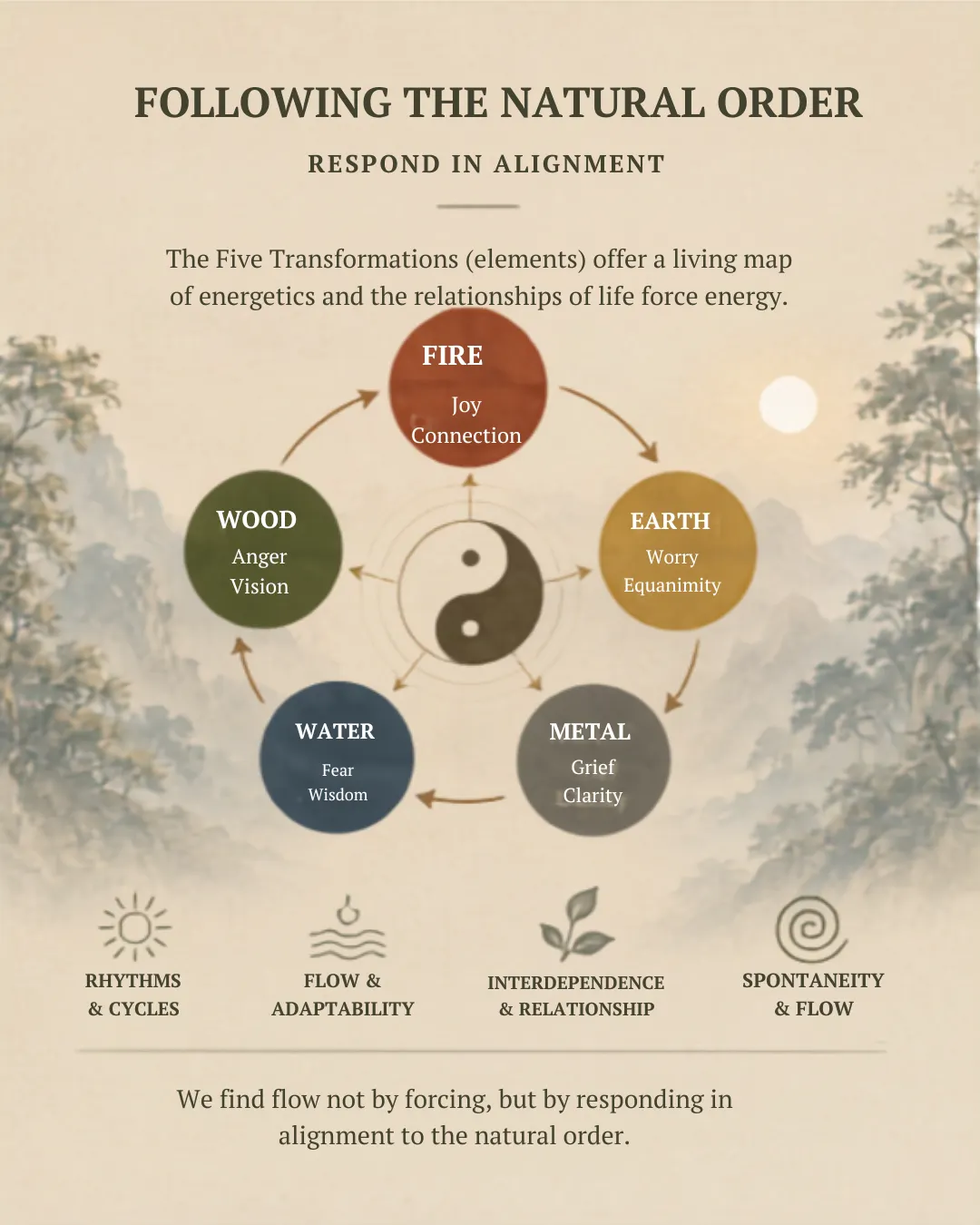
| Five Phase | Movement in life | Human capacity we can cultivate |
|---|---|---|
| Water | Rest, depth, gestation, conserving energy | Wisdom, trust, and responsiveness |
| Wood | Emergence, direction, growth, movement | Vision, flexibility, and purposeful action |
| Fire | Warmth, expression, connection, expansion | Joy, presence, and relational openness |
| Earth | Nourishment, integration, centre, reciprocity | Care, stability, and equanimity |
| Metal | Discernment, contraction, release, refinement | Clarity, value, and the capacity to let go |
These phases are not rigid personality types. They are living movements we can observe within seasons, ecosystems, emotions, relationships, bodies, communities, and cultural patterns.
If you would like to explore which elemental movement may be asking for your attention, begin with the Five Element Reflection. It offers a place to pause, notice your present inner landscape, and listen for what life may be inviting you to cultivate.
What has striving taught me about responding?
Having grown up in a culture that is always striving, I learned to bring too much intent to life. I learned to force, pursue, and tackle resistance.
Letting go of this has taken many years, and it is still a process.
I remember learning through Human Design that I am described as a Generator with sacral authority. Its invitation to respond rather than pursue resonated with the Daoist philosophy of wu wei and its emphasis on finding harmony through less forcing.
That meant I needed to release the belief that if one door did not open, there were ten more doors I should immediately try. I can laugh at that now, although it has been a real pattern of learning.
Through metabolizing this understanding, I came to see that responding is not merely waiting for life to happen. To respond in alignment with the highest possibility, I needed to cultivate my human qualities.
What is human cultivation?
Human cultivation is the patient practice of refining how we perceive, embody, and participate in life. It may include tending the body, emotions, attention, consciousness, relationships, and connection with the living world.
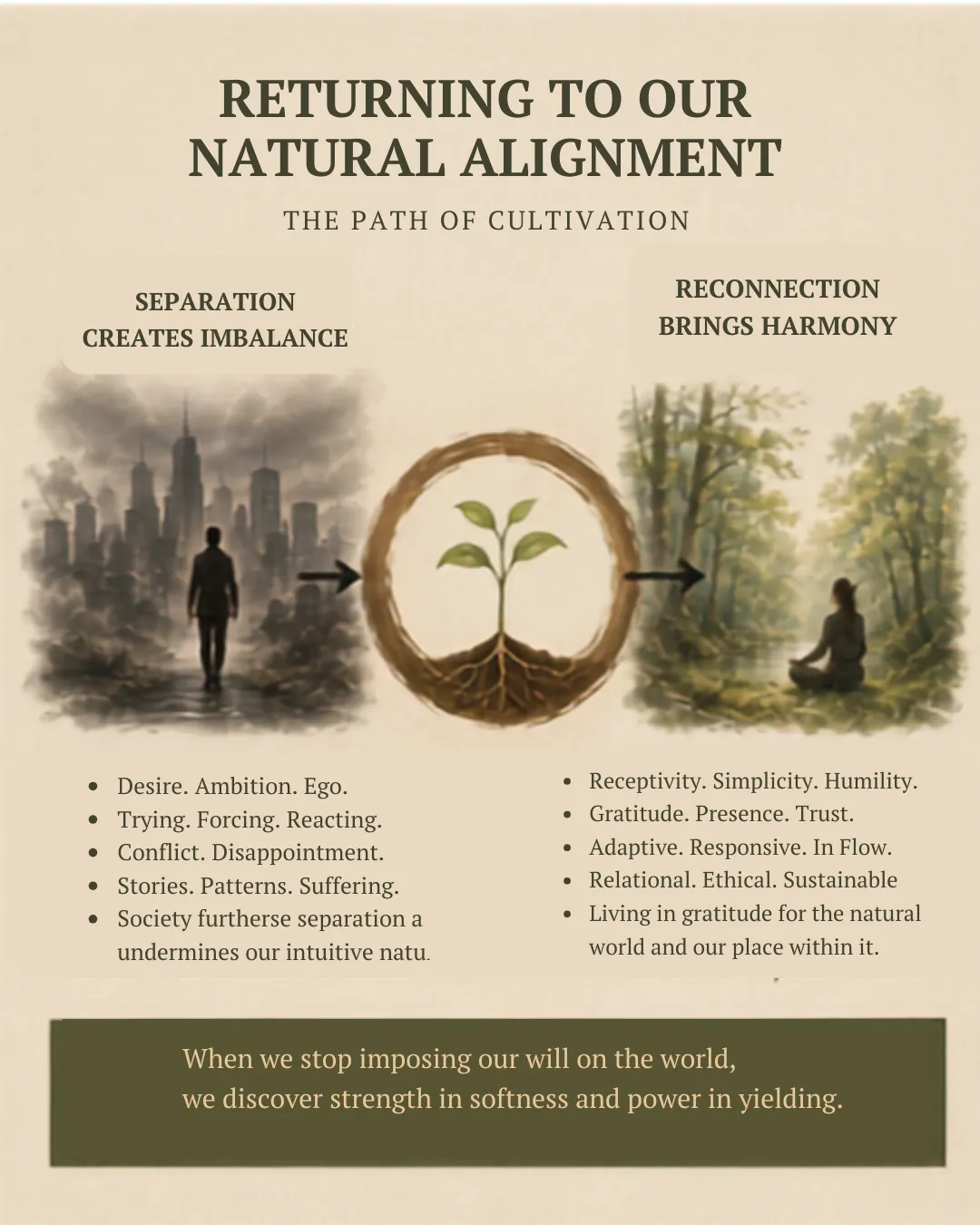
For me, cultivation means attuning myself to the energetics of life while clearing societal and inherited distortions. These influences can cause us to experience ourselves as separate and to inhabit patterns shaped by that separation and by past experiences.
When I speak of separation, I mean the perception that we exist outside nature and outside the ecosystems that nourish and sustain life on Earth.
This separation can lead us to act from desire, ambition, and ego without sensing the whole field of relationship. It contributes to conflict, disappointment, suffering, reactive stories, repeating patterns, and imbalance.
Society deepens this separation when it undermines spontaneous and intuitive action. It trains us to trust external pressure more than our cultivated capacity to sense, discern, and respond.
Why are receptivity, simplicity, and humility important?
The yin qualities of receptivity, simplicity, and humility can increase our capacity to live in relationship with changing conditions. They help us listen before acting, adapt without abandoning ourselves, and recognize that human will exists within a larger living world.
When we are not imposing our will upon the world, we become more adaptive. We can respond rather than react. We can yield without collapsing and find strength within softness.
Deep gratitude and humility toward the natural world also help us recognize our place within the cosmos. From there, we may become less willing to create actions that harm our waters, forests, souls, air, and one another.
In Daoist martial arts, skill, power, and effectiveness arise partly through sensing movement and working with its direction. Power does not always require opposition. Sometimes it is found in yielding, redirecting, or waiting for the appropriate moment.
As Fabrizio Musacchio writes in his reflection on wu wei, ethics, and leadership, wu wei can be understood as fluid, adaptive engagement that remains in relationship with natural order.
How has Daoist-inspired cultivation shaped my work?
For the past sixteen years, a Daoist-inspired lens has taught me to flow with life, find power in yielding, and recognize strength in softness. It has also brought me into a deeper relationship with my emotional landscape.
I have learned to notice where aspects of my consciousness became immaturely frozen in time. I have explored where they were shaped by a dominant culture that often perceives humanity as separate from the whole, attempts to homogenize human beings, and seeks to control nature.
This cultivation has included somatic practice, qigong, yoga, deep self-inquiry, and an ongoing relationship with nature. Together, these practices have drawn me beyond self-improvement psychology and purely objective perspectives.
I have become deeply interested in nourishing human cultivation and in living through a relational view of life.
This is where I believe our human capacity to thrive with all of life begins: in the patient work of cultivating the qualities through which we meet the world.
Can personal flourishing be separated from the flourishing of life?
From a relational and ecological perspective, personal flourishing cannot be fully separated from the conditions of the larger living world. Our inner life, relationships, communities, culture, and ecosystems continually shape one another.
Human flourishing therefore asks more than whether we feel successful or satisfied. It asks whether the way we live contributes to reciprocal nourishment. It asks whether our growth allows other life to grow, whether our choices protect the sources of life, and whether our presence deepens relationship rather than separation.
This does not require perfection. It begins with attention.
What changes when we allow nature to become a primary teacher?
What becomes possible when we cultivate our capacity to respond, rather than repeatedly forcing an outcome?
How might our lives change if flourishing included the waters, forests, animals, communities, and future generations held within our choices?
An invitation to begin
This is part of the work I share through the Living Spiral of Inner Alchemy. The Living Spiral guides us through the patient and loving work of tending our inner garden. It helps us cultivate ways of seeing and relating that allow our relationship with all of life to grow in closer alignment with natural rhythms.
If this speaks to you, begin with the Five Element Reflection. Let it be a quiet place to notice what is resourced within you, what feels out of rhythm, and what may be ready for deeper cultivation.
The Living Spiral of Inner Alchemy opens at the beginning of each elemental season.
Begin with the Five Element Reflection
A free guided reflection to notice your present inner landscape and what may be ready for cultivation.
Get the Five Element Reflection →Frequently asked questions
What is human cultivation in Daoist philosophy?
Human cultivation is the ongoing refinement of attention, embodiment, character, energy, and relationship. It supports wiser participation in life rather than pursuing improvement as an isolated personal achievement.
What does wu wei mean?
Wu wei is often translated as non-action or effortless action. It describes action without unnecessary forcing, guided by receptivity to timing, conditions, and the possibilities present within a situation.
Is wu wei passive?
No. Wu wei can include decisive action. Its distinguishing quality is that action arises in relationship with circumstances rather than from compulsive effort, rigid control, or attachment to an outcome.
How do the Five Phases support human flourishing?
The Five Phases reveal recurring movements of restoration, emergence, connection, nourishment, and release. They help people recognize which capacities are resourced and which may need attention.
How can I begin a Five Element reflection?
Begin by noticing your energy, emotions, relationships, and present season of life. The Five Element Reflection offers a guided starting point.
Editorial references
- Stanford Encyclopedia of Philosophy. “Daoism.”
- Stanford Encyclopedia of Philosophy. “Mind (Heart-Mind) in Chinese Philosophy.”
- Musacchio, Fabrizio. “Wu Wei: The Art of Effortless Action in Daoism.” January 2, 2025.