Rhythm and Cycles: How Aligning With Nature Helps Us Find Ourselves
Finding ourselves as we align with the intelligence of nature
By Sonja Alina den Elzen, R.Ac. ~ Registered Acupuncturist, Daoist medicine practitioner, Five Phase guide, qigong and yoga teacher. Originally published January 22, 2025.
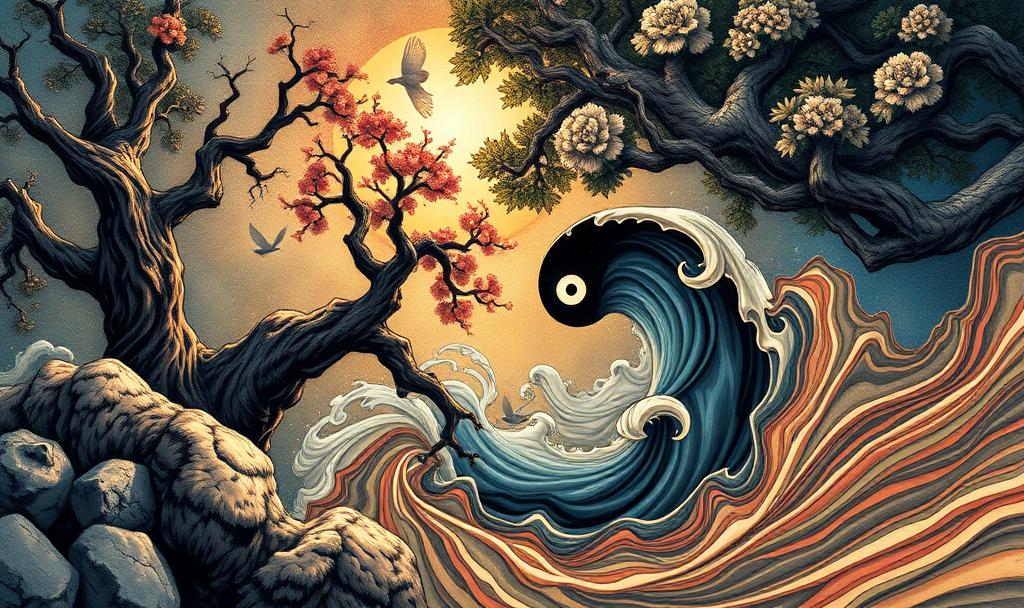
Direct answer: Aligning with nature means learning to notice and respond to daily light, seasonal change, lunar movement, weather, and the living relationships around us. Daoist yin-yang philosophy and the Five Phases offer a map for understanding these rhythms within nature and within ourselves. This practice can support adaptability, self-awareness, belonging, and a more reciprocal relationship with life.
Since the 1950s, a large part of humanity has been on an accelerated path of moving indoors and becoming disconnected from nature. Work, entertainment, and many aspects of social life have moved deeply indoors and online.
The United States Environmental Protection Agency reports that Americans spend approximately 90 percent of their time indoors. Research has also found a marked decline in nature-related words across books, songs, and films since the 1950s. More recent research suggests that the use of nature words in English-language books declined substantially between 1800 and 2019, although some have begun to return.
Our language may be revealing something about our attention. Nature is increasingly written about from a place of longing, as though intimate relationship with the living world belonged to another time.
Why do we feel disconnected from nature’s rhythms?
We can lose our sense of natural timing when daily life no longer asks us to notice sunlight, weather, seasons, plants, animals, or the places that sustain us.
For most of human existence, people lived in direct relationship with the rhythms and cycles of the Earth and cosmos. Light shaped activity. Seasons shaped food, movement, shelter, and rest. Weather asked for an immediate response.
As we become disconnected from balanced daily interaction with nature, we can also lose a felt sense of timing within our bodies. We may know the date without knowing what the land is doing. We may organize ourselves through clocks and schedules while missing the intelligence carried by dawn, dusk, temperature, migration, flowering, decay, and renewal.
This is more than a longing for an idealized past. It is an invitation to notice which forms of intelligence modern life no longer asks us to use.
How does language shape our relationship with the living world?
Language influences whether we perceive nature as a collection of objects or as a living community to which we belong.
Our separation from nature is reinforced through how the English language often others the natural world. We frequently call a tree, river, stone, or animal it. This can turn a living presence into a thing and make nature easier to commodify.
Robin Wall Kimmerer, a botanist and enrolled member of the Citizen Potawatomi Nation, explores this in Braiding Sweetgrass: Indigenous Wisdom, Scientific Knowledge, and the Teachings of Plants. She writes that referring to a person as “it” would be a profound act of disrespect because it removes personhood and kinship.
Kimmerer describes how Potawatomi grammar uses forms of animacy for much of the living world. This animacy extends beyond plants and animals. Water, rocks, places, and other presences may also be encountered within a grammar of life and relationship.
She also observes that English is composed of roughly 30 percent verbs, while Potawatomi is composed of about 70 percent verbs. This verb-rich grammar presents a world in motion. A bay, for example, is not only a static thing. It is water actively being a bay.
This does not mean English speakers should borrow Indigenous language without context. It asks a more intimate question: How might our perception change if we addressed the world as alive?
What do yin and yang teach us about natural rhythm?
Yin and yang describe complementary movements through which life continually changes, balances, and transforms.
Daoist cosmology offers another lens through which we can perceive the constant living flux of nature and our own nature. Yin and yang are not fixed opposites. They describe relational qualities that arise together: darkness and light, rest and activity, inward movement and outward expression, receptivity and action.
The rising sun does not defeat the night. Winter is not a failure of summer. Each carries a necessary movement within a larger cycle.
When we view ourselves through this lens, fatigue may become a request for restoration. Grief may carry the movement of release. Anger may show us where life wants motion, protection, or renewed direction. Emotion becomes intelligent movement rather than an obstacle to control.
What are the Five Phases in Daoist philosophy?
The Five Phases are Wood, Fire, Earth, Metal, and Water. They describe recurring patterns of change rather than five static substances.
The Five Phases are also called the Five Elements or Five Transformations. They provide a relational map for observing energy, seasons, emotions, human development, and the movements of life.
| Five Phase | Seasonal movement | Energetic quality | Human inquiry |
|---|---|---|---|
| Wood | Spring | Emergence, vision, direction | What wants to grow or move? |
| Fire | Summer | Expression, warmth, connection | What brings me into radiant relationship? |
| Earth | Late summer and seasonal centre | Nourishment, integration, belonging | What helps me feel resourced and centred? |
| Metal | Autumn | Refinement, release, meaning | What is complete, precious, or ready to be released? |
| Water | Winter | Rest, depth, conservation | What wisdom emerges when I become still? |
The Five Phases can help us understand our psychology, emotional energetics, physical bodies, relationships, expressions, and imbalances. They also teach us to read the environment and become more responsive, resilient, and adaptive.
They are a map, not a rigid classification system. Nature remains the teacher.
How do daily light and seasonal cycles affect the body?
Light is one of the primary signals regulating the human circadian system, including sleep-wake timing and melatonin production.
The calendars and clocks we use are useful agreements. They help us coordinate a complex world. Yet standardized time does not always keep us attentive to natural time.
A solar year contains approximately 12.37 lunar cycles, which is why lunar and lunisolar calendars require different ways of reconciling months with seasons. The problem is not simply that a twelve-month calendar is unnatural. The deeper separation occurs when calendar time becomes the only time we perceive.
We can lose touch with the moon’s movement, the seasonal arc of light, and the changing relationship between sunrise and sunset. We may also organize our daily activity without regard for the natural signals that shape our bodies.
The U.S. National Institute of General Medical Sciences explains that light received through the eyes helps the brain’s master clock regulate melatonin. Melatonin usually rises in the evening as light fades, contributing to sleepiness. Artificial light at night can alter this timing.
Natural rhythm is therefore not only philosophical. It is embodied.
What do we lose when natural time becomes invisible?
When natural time becomes invisible, we may lose sources of orientation, belonging, embodiment, and practical knowledge about change.
We now have increasing access to a global world, with information and goods at our fingertips. Yet many people feel less physical, psychological, and spiritual connection with one another and the natural world.
We may pay a price through our health, our sense of self-worth, our belonging, and our understanding of how body, mind, and spirit move together.
It can feel as though we have lost an operating manual. The wisdom of nature once helped people recognize when to initiate, express, gather, release, conserve, and begin again.
This wisdom has not disappeared. It remains present in the land, our bodies, and the relationships between them. What may be missing is our sustained attention.
How can nature help us find ourselves?
Nature helps us locate ourselves by giving us living reference points for energy, emotion, change, and relationship.
When we attune to the rhythms and cycles of nature, we do more than witness them. We begin to embody their movements.
We may recognize the quiet conservation of winter within our need to retreat. We may feel spring’s directional movement within a new vision. We may discover summer in our longing for warmth and connection, Earth in our need for nourishment, and autumn in the clean sorrow of release.
This can make flow more accessible because we are no longer asking every season of life to produce the same kind of energy. We can locate ourselves in space and time through a relationship with the cosmos. It is part of what flourishing can mean.
Most dominant cultural systems will continue to operate through standardized calendars, productivity measures, and shared schedules. We do not need to abandon them. Perhaps this is like learning to speak more than one language.
We can live within civic time while also perceiving solar, lunar, seasonal, bodily, and ecological time. We can learn to walk between these worlds.
What does it mean to live in rhythm with nature?
Living in rhythm with nature means developing an ongoing practice of observation and response, rather than trying to impose one fixed rhythm upon every person or season.
For the past 15 years, I have been learning what connection means within the deeper layers of my being. I use the Five Phases as a framework and lens through which to explore the energetic movements and relationships of nature.
I observe what each season calls me into energetically and physically. I notice how seasonal movements reflect our emotional landscapes, our individual expressions and imbalances, and our relationships with one another.
Through this practice, I come home again and again to the realization that Nature herself is our master teacher: the macrocosm guiding the microcosm all around and within us.
This is not a demand to become perfectly synchronized with nature. There is no single ideal schedule that suits every body, climate, culture, or stage of life. Cultivation begins through relationship: noticing, listening, responding, and noticing again.
A Five Element reflection for locating yourself within the cycle
You may wish to pause and ask:
- Which phase of a cycle am I living within now: emergence, expression, integration, release, or rest?
- What is the season and living land around me expressing?
- Where am I asking myself to produce energy that is not presently available?
- What might become possible if I responded to this moment instead of forcing it?
- Which natural rhythm would I like to notice more closely this week?
If you would like a guided way to explore these questions, begin with the Five Element Reflection. It will help you recognize the elemental movement most present in your life and where nature may be inviting you into deeper relationship.
Continue through the Living Spiral of Inner Alchemy
In nature, everything moves through cycles of birth, life, transformation, release, and renewal. The Living Spiral of Inner Alchemy is my year-long group mentorship rooted in Daoist philosophy, the Five Phases, emotional alchemy, embodiment, and relationship with the living world.
It is an invitation to tend your inner ecology patiently and learn from the intelligence of each elemental season.
Locate yourself within the cycle
Begin with the free Five Element Reflection, or explore the year-long journey through the elemental seasons.
Frequently asked questions
What are nature's rhythms and cycles?
Nature's rhythms and cycles are recurring patterns of change, including day and night, lunar phases, tides, seasons, growth, decay, migration, rest, and renewal. These cycles influence ecosystems and provide humans with cues for bodily and psychological orientation.
How do nature's cycles affect humans?
Natural light directly influences human circadian rhythms and melatonin timing. Seasonal and ecological cycles can also provide meaningful frameworks for understanding energy, emotion, activity, rest, and change.
What is the difference between the Five Elements and Five Phases?
Both terms commonly refer to Wood, Fire, Earth, Metal, and Water in Chinese and Daoist traditions. “Five Phases” emphasizes dynamic movements and relationships, while “Five Elements” can sound more like fixed substances.
What is a Daoist approach to living with nature?
A Daoist approach observes how life moves through complementary and changing relationships. Yin-yang and Five Phase philosophy can guide a person toward responsive action, adaptability, balance, and respect for the natural order.
How can I reconnect with natural rhythms?
Begin by observing sunrise and sunset, weather, seasonal changes, the moon, local plants, and your body's energy. Keep the practice simple. Notice what is changing and consider what response the moment asks from you.
References
- U.S. Environmental Protection Agency. “Indoor Air Quality.”
- National Institute of General Medical Sciences. “Circadian Rhythms.”
- Kimmerer, Robin Wall. Braiding Sweetgrass. Milkweed Editions, 2013.
- Kesebir, Selin, and Pelin Kesebir. “A Growing Disconnection From Nature Is Evident in Cultural Products.” Perspectives on Psychological Science, 2017.
- Richardson, Miles. “The Extinction of Experience: A Simulated Investigation of Human-Nature Disconnection Since 1800.” Earth, 2025.